
Lee County Court Records After a Jail Arrest
A jail arrest and a court case are linked, but they are not the same record. The arrest creates a booking at the Lee County Jail. The court record opens when the Lee County State's Attorney files charges and a case number is assigned. From that point the court tracks every filing, hearing, plea, and ruling. The jail does not run that side and says plainly that it does not give out court dates, pointing people to the court instead.
Keep the two halves clear in your head. The booking side, with the roster and the booking detail, lives on the jail inmate records page, and any booking photo question is covered on the jail roster mugshots page. The court record after an arrest is the charges the prosecutor actually files and how those charges move through the case, and that is the side the sections below follow.
How to Find Lee County Court Records After an Arrest
Lee County court cases are searchable through the FullCourt Enterprise public portal, linked from the Lee County Circuit Clerk. The portal opens after you click a public log-in button, and no username or password was needed in review. From there you can search by party name or citation and read the court calendar.
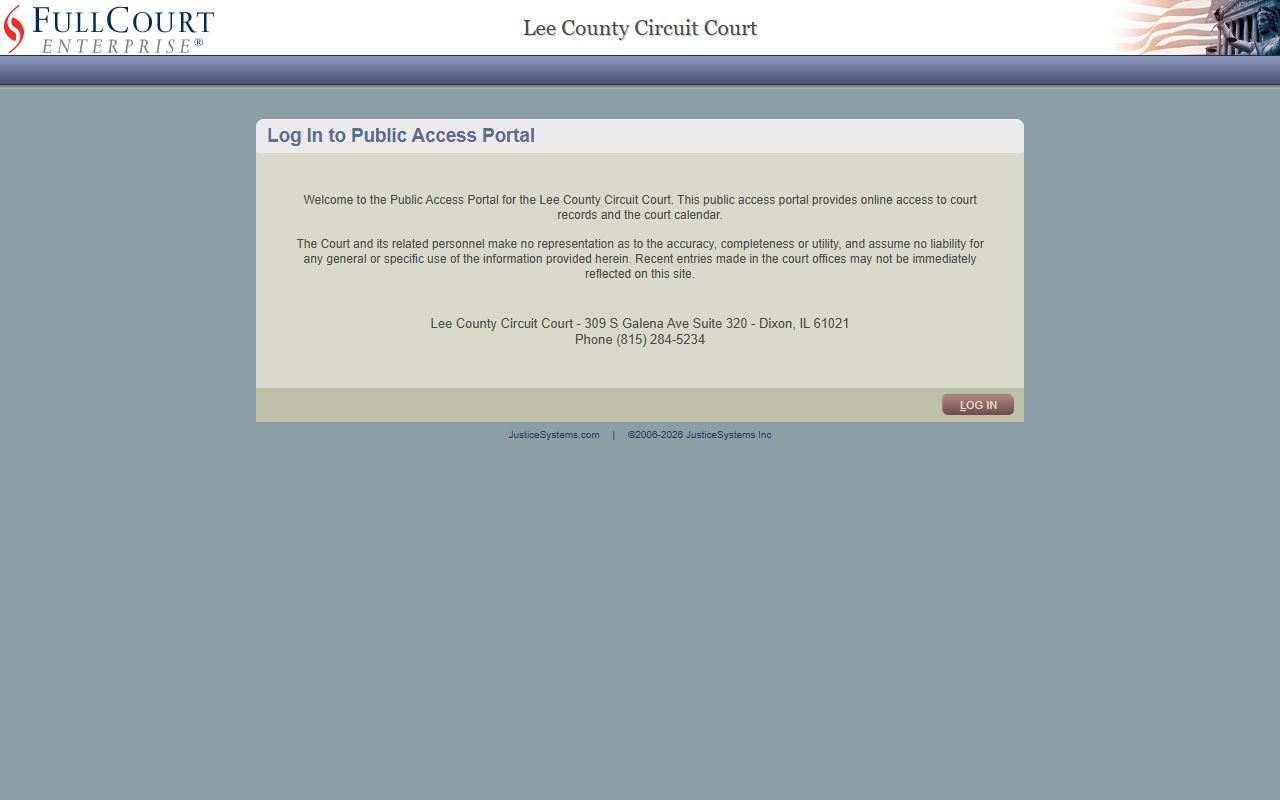
The portal landing page shown above warns that recent entries made in court offices may not appear right away. A same-day arrest can show in the jail arrest summary before the court file is fully posted. The steps below walk through a party search.
- Open the FullCourt portal from the Circuit Clerk page and click the public log-in button.
- Choose Cases by Party Search and enter the defendant's last and first name.
- Open the matching case and read the charge list and case number.
- Check each charge for its code, class, and current status.
The party search accepts more than a name. The field table below comes from the public search screen.
| Field Label | Type | Required | Notes |
|---|---|---|---|
| Last / First / Middle | Text | Last name focused | Basic name search; first and middle are optional. |
| Case Type | Radio | No | All, Criminal, Civil, or Juvenile. |
| Criminal Case Role | Dropdown | No | Includes Defendant, Witness, Victim, Interested Party. |
| Start / End Date | Date picker | No | Advanced fields to narrow by filing date. |
| Buttons | Button | n/a | Search, Soundex for spelling variants, and Cancel. |
The court calendar is a useful second route. It lists criminal docket types that track the post-arrest path, such as First Appearance, Criminal Arraignment, Preliminary Hearing Status, Jail Call, Public Defender Call, and Failure to Appear. A newly arrested person may show up first as a calendar event before the full case file is posted online. For a statewide criminal-history check rather than one county case, the Illinois State Police handles name-based and fingerprint background checks.
How Charges Get Filed After an Arrest
The court record starts with a charging document. After the booking, the prosecutor reviews the case and files the formal charge that opens it. The form that filing takes depends on how serious the offense is. The three main types appear in the table below.
| Complaint | Information | Indictment | |
|---|---|---|---|
| Filed By | Officer or prosecutor | Prosecutor | Grand jury |
| Common For | Misdemeanors | Many felonies | Serious felonies |
| Starts | The case | The case | The case |
The charge at booking is not always the charge that gets filed. The arresting agency lists an offense, then the prosecutor may file the same charge, a different one, or none at all. That is why the court record, not the arrest report, is the source for what a person actually faces.
Charge Status and What It Means
Charges shift as a case moves. They can be amended, reduced, added, or dropped. A booking offense on the arrest report can read differently from the final filed charge. The terms below are the common status labels you will see in a court file.
| Status | What It Means |
|---|---|
| Pending | The charge is filed and the case is still open. |
| Amended or Reduced | The charge was changed, often to a lesser offense. |
| Dismissed | The charge was dropped and is no longer pursued. |
| Nolle Prosequi | The prosecutor chose not to go forward on that count. |
Note: A status can change between hearings, so a charge shown as pending today may be amended or dismissed at the next court date.
Circuit Clerk Searches and Fees
When a case is old or hard to find online, the Lee County Circuit Clerk runs a manual search. Amy Johnson is the Circuit Clerk, and the office sits on the third floor of the courts building at 309 S. Galena Avenue, Suite 320, Dixon, IL 61021. The office searches both misdemeanor and felony records on request, in person or by mail.
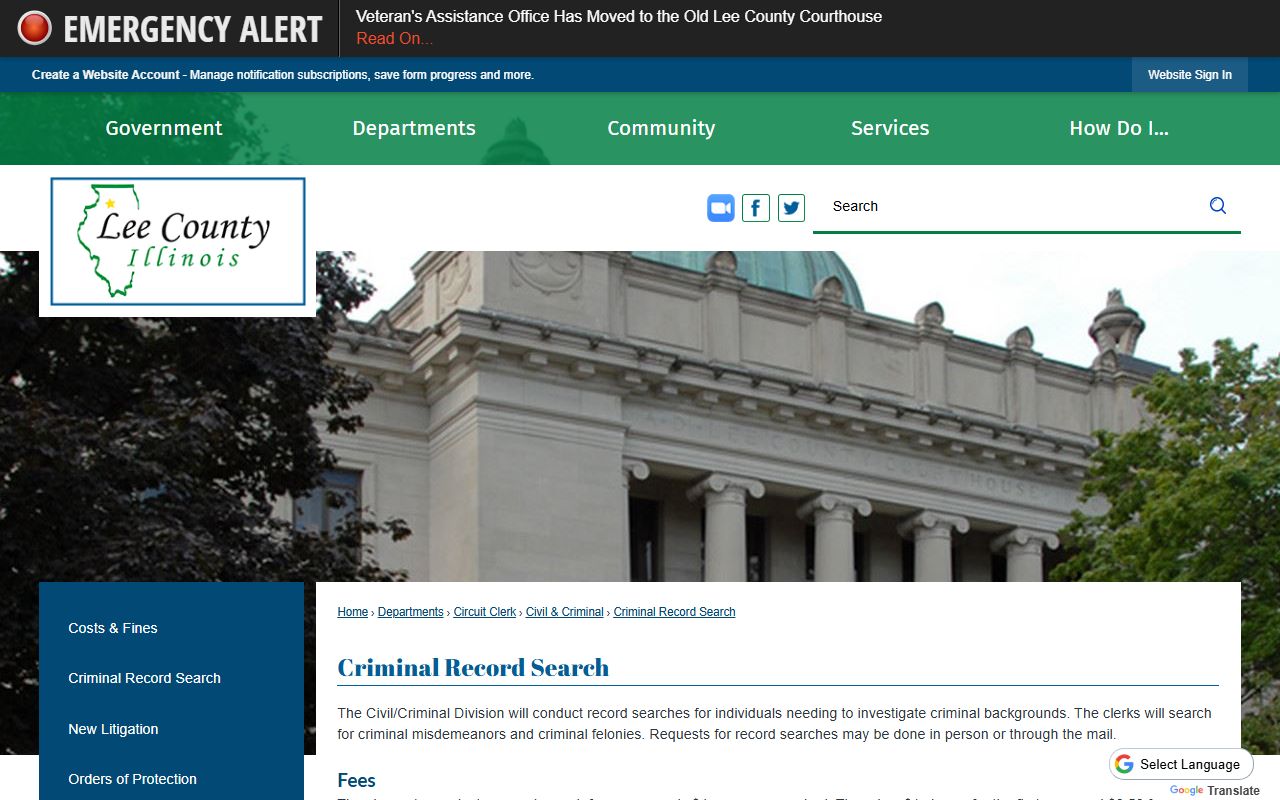
The criminal record search page shown above sets the fees in plain numbers. A name search is $4 per name for each year searched. Copies cost $1 for the first page and $0.50 for each page after. Cases before 1988 are $6 per name per year, must be asked for in writing with a stamped return envelope, and can take up to four weeks. A certified document is $2 on top of copy fees.
The Lee County State's Attorney's Role
The Lee County State's Attorney's Office files and prosecutes criminal cases for the people of Illinois. The county lists Charles Boonstra as State's Attorney, with the office at 309 S. Galena Avenue, Dixon, IL 61021 and a phone of 815-284-5245. The prosecutor decides what to charge, whether to amend or drop a count, and how to resolve the case.
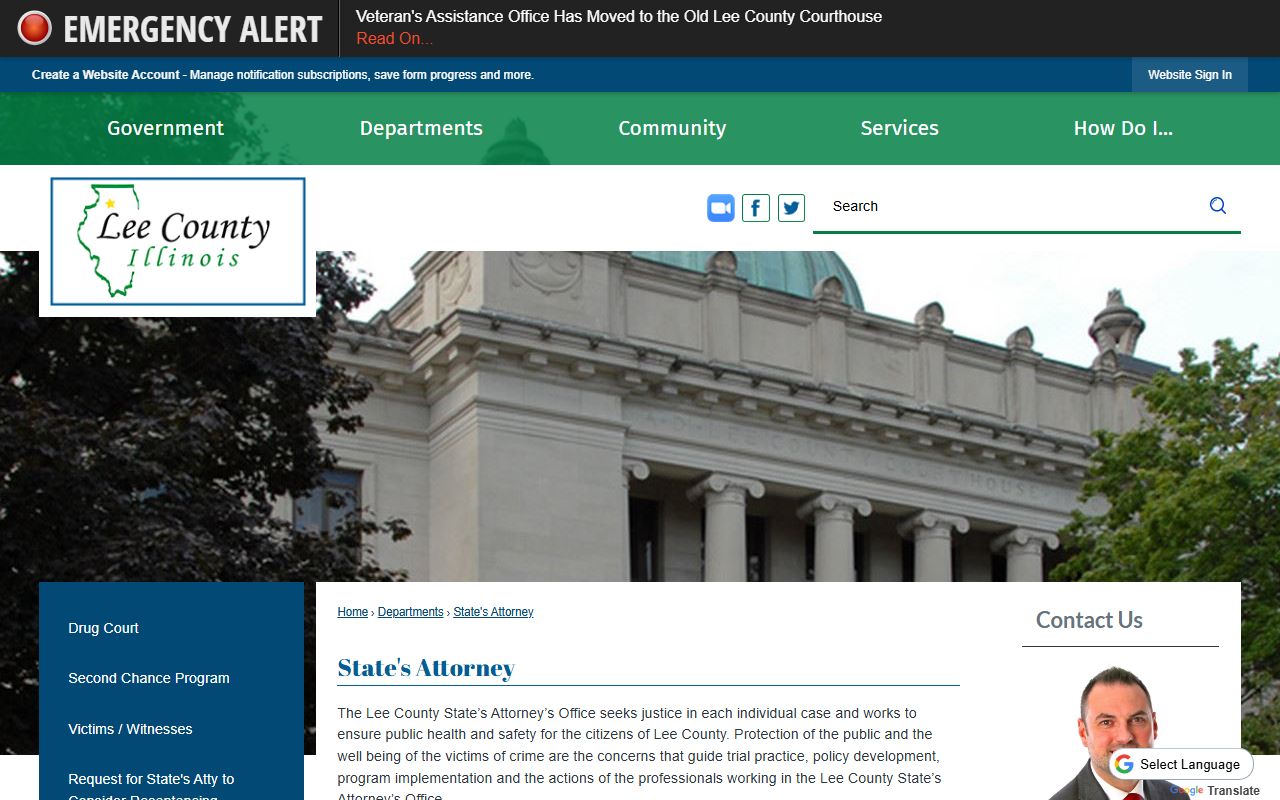
The office page above also covers victim and witness help and the local Second Chance Program, a route for some first-time offenders to avoid a felony conviction. That program runs about 12 months, carries an application fee and a program fee, and ends in a dismissal with prejudice when completed. Public court documents themselves come from the Circuit Clerk, while the prosecutor holds its own case files, so a records request should go to the right office for the record you want. The office has also linked its growth in recent years to the workload from the 2023 pretrial release reform.
Bond and Release After an Arrest
Release in Illinois changed sharply in 2023. The state ended cash bail on September 18, 2023, so a person is no longer held simply because they cannot pay. Instead a judge weighs release at a first appearance. A prosecutor may file a petition to deny pretrial release, and if the judge grants it, the person stays in the Lee County Jail while the case proceeds. If release is ordered, the court sets conditions rather than a money amount.
The jail page still lists payment methods for court-ordered amounts, such as cash, certified checks made out to the Circuit Clerk, and card payments through a third-party processor with a fee. Treat those as payment mechanics for court obligations, not as the main route to release. To check a person's release or case status, look at the court record and call the Circuit Clerk at 815-284-5234, and call the jail only to confirm custody.
Warrants That Lead to an Arrest
Lee County does not publish an active-warrant search or a most-wanted page. The arrest summary can show warrant-related arrests after they happen, with terms such as failure to appear, body attachment, or an original charge warrant. That report is a record of past arrests, not a live warrant list. To check for a possible warrant, contact the Circuit Clerk, look at the court file, or speak with an attorney before acting.
Charges vs. Convictions
Being arrested and charged is not the same as being convicted. A charge is an accusation that opens the court case. A conviction is the result, reached by a plea or a verdict. The table draws the line.
| Charge | Conviction | |
|---|---|---|
| Stage | Accusation | Verdict or plea |
| Burden of Proof | Probable cause | Beyond a reasonable doubt |
| Public Record | Yes | Yes |
Sealed vs. Expunged Court Records
Illinois law lets people clear some records after a dismissal or an eligible outcome. Sealing hides a record from most public view. Expungement goes further and treats the record as if it never existed. The standardized Illinois Courts expungement and sealing forms are accepted statewide, and the Lee County Circuit Clerk handles the local filing.
| Sealed | Expunged | |
|---|---|---|
| Visibility | Hidden from most public view | Destroyed or treated as if it never existed |
| Law Enforcement | Limited access | Very limited access |
| Eligibility | Set by 20 ILCS 2630/5.2 | Set by 20 ILCS 2630/5.2 |
Background Check Considerations
A casual court lookup is not the same as a formal background check. Employers and landlords that screen people must follow the federal rules for consumer reports. A public court search is fine for personal knowledge, but it is not a legal screening tool.
Important: This site is not a consumer reporting agency under the FCRA, and its information may not be used to screen for jobs, housing, credit, or insurance.
Restricted Court Records After an Arrest in Lee County
Not every record is open. Juvenile cases are generally confidential. Sealed or expunged matters drop out of public view. A dismissed charge may be withheld, and records tied to an open investigation can be held back under a Freedom of Information Act exemption. When a court file is not visible online, the limit is often one of these rules rather than a gap in the system.